
The DFW Writer's Conference

So, the whole reason I have this here "Death Writer" blog is because I wrote a book about my anxiety fueled journey exploring death.  I would never have studied death if it hadn't been for school.  I'm the kind of person who thrives in an environment where I'm held accountable. Look at death!  Okay!

One day I hope to sell Death Becomes Us.  You know, so I can pay off those student loans. Grad school was expensive, but totally worth it.  Heck, even if my manuscript never sees the vaguely florescent light of a Barnes and Noble or the computer screen glow from a Nook I'm a much better person for taking the trip.  Ask my family.
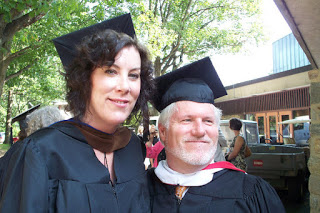
Me & Tom French, one of my mentors at school.

And if I'm going to be totally honest, I'd like to see something I wrote in a bookstore. At the rate I'm going, however, I'm afraid by the time this thing makes it into print, print will be gone.  E readers are cool.  I guess.  I don't own one.  I like paper.  But I am not violently opposed to them.  Whatever happens, happens.
Here I am looking at the "stars" on the ceiling at the conference.
I think I've had a glass of wine or three.

So, last weekend I attended the DFW Writer's Conference in lovely Hurst, TX.  I've been to a few conferences in my day, but I have to say that this one was particularly enjoyable.  For one, the Hurst conference center was beautiful and there were snacks.  Lots and lots of snacks.  You wouldn't think that snacks would make or break a conference, but you would be oh so wrong if you thought that snacks were unimportant.  People, myself included, like to eat a cookie or grab a cup of coffee when their brain is on overdrive trying to absorb all the output..  And there was a ton to absorb.

I thoroughly enjoyed James Rollins' Keynote Address.  I've never read any of his books, but that doesn't matter.  He still gave a very funny, heartfelt speech about becoming a writer.  And who doesn't love a man who will openly admit that he approached Ron Howard at his first conference thinking he was someone he knew.  Plus, he used to be a veterinarian and despite the fact that he's now a best selling author, he still volunteers his services once a month at a spay and neuter clinic.

My favorite class was called Fast Draft and was taught by Candace Havens.  This woman is not only funny and an excellent teacher, she's also a trooper.  I'm not going to go into why I think she's a trooper, but trust me, she is. I just figured out the ending of my book after months of pondering and hoping for some sort of miracle happy ending.  Books about death, even ones written in sort of a humorous tone are kind of heavy, and the damn thing was right in front of my face.  Since this is a memoir, there has to be some sort of detachment in order to reflect on the events.  I've finally got it!  And it took one night of fast draft to free myself up.  I figuratively vomited my ending.  Now I'm wading through the mess.  Ewwwwwwww!

I also had three requests for my proposal, but I kind of live by the motto, "Expect nothing and you'll never be disappointed."  So, if anything comes of it, you'll be the first to know.  I'm lying.  You'll probably be the third to know.  Mom and husband come first because they've had to put up with me a lot longer than you have.

Yesterday I found out that I'm going to be able to attend another writing conference in July called the Mayborn Literary Nonfiction Conference.  It's in Texas.  Yee haw!

So, bloggers, what's your favorite conference?  Why?  Are snacks important?  Discuss...

Don't write and wondering where all the death is in this post?  Check back Monday when I hope to have two, count em, TWO posts.  It is Memorial Day, after all.

Working with Death Wednesday: Pediatric Surgical Nurse

Today I'm starting my new feature where I talk with people who work in a profession that encounters death.  I am pleased to welcome Jessica Salyer to the death writer blog! Jessica is a pediatric surgical nurse with over twelve years of experience. When not nursing, she can be found with her husband and three children. If she has any free time it's spent on her laptop where she is busy working on her first YA novel or blogging. 

DW:  So, why did you want to become a nurse?

Jessica:  Growing up my mom was in and out of hospitals. I saw the impact that nurses and doctors made on my mom's and my life. I realized that the time when people are in the hospital is a scary out-of-control time and the nurse's are the ones that can make or break the experience.
DW:  Did you realize in the beginning of your professional journey that you would be dealing with death?  I  know this seems like a ridiculous question, but I have to ask it.

Jessica:  Death has always been a reality in my life. When you grow up with a mother who has had multiple kidney transplants and on the brink of death multiple times, you grow up with a different view of death. Instead of it being a mysterious thing you know nothing about, you grow up with it. You know that it's always a shadow there in the background. I've never had any illusions about death or what I would be dealing with as a nurse. It's part of why I became one.
DW:  Did you have personal experience with death before becoming a nurse?

Jessica:  Before becoming a nurse I had a few family members die. My Great-grandma and Great-grandpa died when I was younger. Then when I was in nursing school my two uncles died within six months of each other. This was a very hard time for my family. Especially my Grandmother.  She lost her two sons and then less than a year later we lost my mom. My grandmother lost three of her four children with in a year and a half of each other. It was hard enough for me losing them, I can't imagine what my grandmother went through. She is the strongest woman I know.

Losing my mom was hard for me on two levels. First, the fact that I lost my mom and my best friend. Second, I had just become a nurse when she went into rejection the last time. Suddenly, I had all the answers and made all the decisions. I picked her doctors, signed consents, decided if and when she would have surgery, and when the time came decided they should let her go. I questioned my ability to make those decisions for many years after that. Questioned whether I made the right ones. Questioned that if I had made different ones she would still be here.

DW:  Do you remember the first person who died?

Jessica:  (note: In order not to give any patient identifiers I replaced her/him with them/they and changed the patients name to Patient.) Certain patients stick out in my mind and will always be with me. I do a lot of congenital heart defect surgery so sometimes the outcomes aren't so good. (Very technical terminology I know.) When I first started doing hearts there was this little baby that we operated on quite a bit, that baby sticks out. A few years later there was this patient who had a heart transplant. The patient did fine during surgery but after had some complications and never regained consciousness. I took that patient from the parents. I was the last person that saw that patient alert, smile, and say good bye to their mom and dad. I did not deserve that privilege. I've done organ procurements and those are never easy. I try to remind myself that they have died anyway and now they're saving someones life. However, when the anesthesiologist turns off the machine and walks out, it's very surreal. There's another one that sticks out lately. This patient hasn't died yet. I say yet because Patient has osteosarcoma (bone cancer) with tumors that went to the lungs. Patient had to have their right leg and pelvis removed. They also have had their tumors in their lungs resected (taken out) multiple times. The last time we did surgery, we only did it to let Patient live through the summer. Patient wanted to live long enough to go on a road trip this summer with a family member. Hopefully they'll make it that long. I admire Patient. The positive outlook they have is refreshing. Although they know they are going to die, it doesn't stop them from living.

DW:  How did you deal with that?

Jessica:  Death is inevitable. I cannot control which one of my patients live or die. What I can do is make sure that the interaction that they have with me is the best that they can possibly have. I remind myself that if they are going to die, they would die whether I was there or not, but maybe I could impact it, maybe I could make it a little bit better.

DW:  What kind of nurse are you?  

Jessica:  I'm a pediatric surgical nurse. I don't have a lot of patient interaction while my patients are awake, but I feel like what I have is very important. It's a very stressful time in their lives. Parents have to give their children over to a perfect stranger, to who-knows-what is going to happen to them. I have a small window of opportunity to gain a rapport with the family. To make the parents and child comfortable with me; so, maybe it won't be so hard.

DW:  Do you find yourself keeping some sort of emotional distance from your patients?  

Jessica:  I'm a very emotional person, so I have a hard time separating. I do try and remind myself that whatever happens to them is meant to happen. I just try to make it better. 

DW:  Is there any sort of support for your staff after a particularly sad or challenging day?

Jessica:  There are people who we can talk to and sometimes if there is something very traumatic they have a debriefing.

DW:  What is the most uncomfortable part of your job?

Jessica:  Taking the patients from their parents. It's not so bad with simple cases, but with bad cases or complex surgeries where the outcome might not be so good, it gets hard. Also when the dads cry. I expect the moms to cry, but when the dads cry, I almost start. 

DW:  As a nurse, is there any advice you have for people who read this blog?

Jessica:  Be your own advocate. Don't be afraid to ask questions or for second opinions. You have every right to know exactly what's going on with your health care. Also organ donation. You don't need your organs when you die, but someone else might. Think about this... my mom had her first kidney transplant before I was born. She had me and my brother. I had three kids and my brother had one. That's seven people that one person saved from their one kidney. Not to mention my future (much in the future) grandchildren.

Thank you so much Jessica for sharing your story with me today.  And thank you for the work you do.  Nurses are the greatest.  And I couldn't agree with you more about organ donation.  My brother-in-law is on the heart transplant list.  If anyone out there is feeling generous, you can donate to Jason's heart transplant fund.  New hearts cost a lot of money.

Tuesday Movie: Into the Abyss


Just as I prefer nonfiction to fiction when I pick out a book, I love documentary films, especially when they are about subjects that I find fascinating.  Let's face it, the truth is sometimes way stranger than fiction.  I know there are thousands out there who would love to argue that point with me, but let's just agree to disagree.

Which is good advice concerning the subject of this film.  It's about the death penalty and no matter which side of the fence you're on, I know I probably can't make you change your mind.  Not many people have given much thought to the death penalty because it's not something that concerns them in their day to day lives.  Heck, most people don't even want to contemplate their own mortality, so why should they care about some stranger?  I know that's callous sounding, but it's true.  So, I want you to be brave and just watch the film and see what happens.

Into the Abyss opens with Richard Lopez, a death row chaplain standing in Joe Byrd Cemetery talking about his job.  And then Mr. Herzog asks Lopez to talk about an incident with a squirrel.  You're probably thinking, huh?  I was too.  I also interviewed Mr. Lopez, but we didn't talk about furry woodland creatures.  Our talk was more about God and his (Lopez's not God's) presence during an execution. But, now that I've seen this interview, I think questions about squirrels might be the ticket!.

Okay, sorry for the digression. The film focuses on a murder that occurred in a small town in Texas.  Three people were killed.  The reason?  A car.  Herzog interviews the two men who committed the murders as well as the victim's family members. Both sides are given equal time. 

It is a slow film, but it is haunting.  I very much enjoyed Herzog's look into these people's lives.  He is a wonderful filmmaker.  Who else could make you think about life, death, and for a fleeting moment, squirrels?

If you've seen it, I'd love to hear what you thought about it.